
Constitutional Rights
Gombe Residents Encouraged to Voice Grievances at NERC Customer Complaints Meeting

By Abdulaziz Ibrahim Hassan
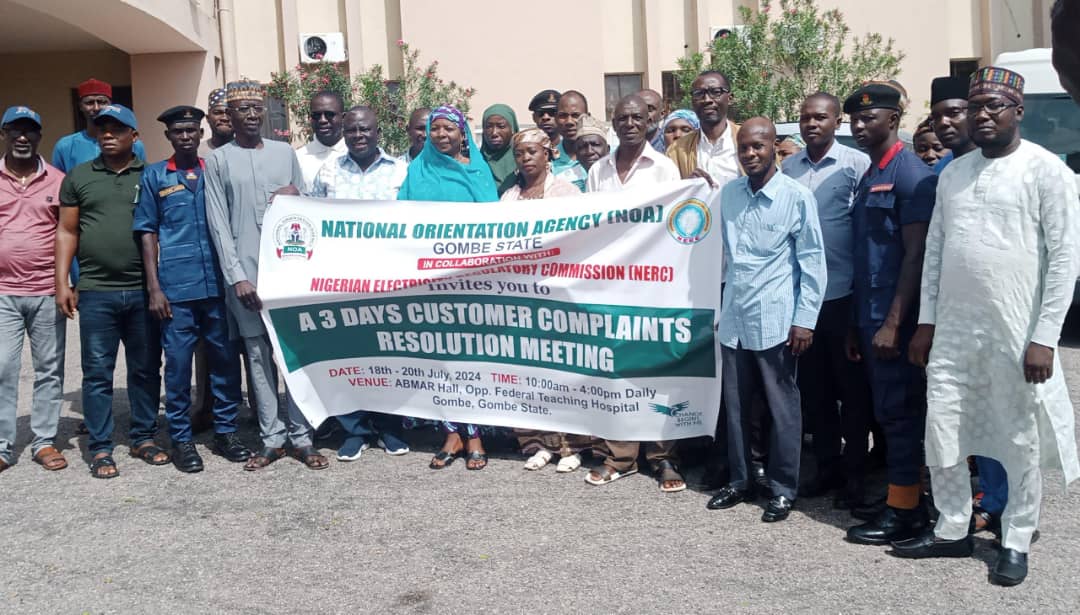
Residents of Gombe State are being urged to attend a crucial meeting with the Nigerian Electricity Regulatory Commission (NERC) to present their grievances and complaints.
This call to action was made by the Director of the National Orientation Agency (NOA) Gombe State Office, Mrs. Adaline Waye Patari, during a mega rally organized by the agency in collaboration with NERC, held in Gombe.
Represented by her Deputy, Maimuna Abubakar, Mrs. Patari emphasized that the primary goal of the rally is to invite the public to a three-day Customer Complaints Resolution Meeting. During this event, NERC will listen to complaints from electricity users and devise lasting solutions for effective service delivery.
The NOA Director highlighted the importance of Gombe State residents attending the meeting to ensure their voices are heard and their issues are addressed.
In their separate speeches, the Chairman of the Gombe State Oil Millers Association, Alhaji Sani Yau, and the Organizing Secretary of the Gombe State Rice Processors Association, Shehu Muhammad Abubakar, commended the NOA and NERC for their efforts and pledged their full cooperation and support.
The meeting to receive complaints will take place from Thursday, July 18 to Saturday, July 20, 2024, from 10:00 AM to 4:00 PM daily at Abmar Hall, opposite the Federal Teaching Hospital, Gombe.

By Our Court Reporter
The High Court No. 2 in Gombe has sentenced a 25-year-old man, Hassan Mohammed, to death by hanging for the murder of his former wife, Halimatu Sadiya Adamu, after she reportedly refused to remarry him.
Delivering the judgment, Justice Abdulhamid Mohammed Yakubu held that the prosecution had proven its case beyond reasonable doubt and found the defendant guilty of culpable homicide punishable under Section 221 of the Penal Code Law.
Hassan Mohammed, a resident of Falangaya village in Dukku Local Government Area of Gombe State, was accused of attacking his former wife with a knife on March 25, 2025, at about 1:00 p.m., fatally slitting her throat.
According to the prosecution, the tragic incident occurred after the deceased rejected the defendant’s request to reconcile and remarry him following the end of their marriage.
The Director of Public Prosecution in Gombe State, Barrister Abubakar Kungudo, who led the prosecution, told the court that the defendant’s action constituted culpable homicide contrary to Section 221 of the Penal Code Law.
When the charge was first read to him, the defendant pleaded not guilty.
During the trial, the prosecution presented six witnesses who testified before the court, narrating what they witnessed at the scene of the incident. The knife allegedly used in committing the crime was also tendered and admitted as an exhibit.
Counsel to the defendant, Barrister Habib Alkali, cross-examined all the prosecution witnesses in an attempt to challenge their testimonies.
In his defence, the accused person testified on his own behalf and denied committing the offence. However, he was also cross-examined by the prosecution.
After reviewing the evidence, witness testimonies, the confessional statement of the defendant, and the outcome of the police investigation, Justice Yakubu ruled that the prosecution had successfully established the charge against the accused.
The court therefore convicted Hassan Mohammed for culpable homicide and sentenced him to death by hanging in accordance with Section 221 of the Penal Code Law.
The judge noted that the severity of the crime and the weight of the evidence left the court with no option but to apply the full weight of the law.
The case has drawn attention to the growing concerns over domestic violence and relationship-related killings in the society.

By Our Correspondent
In a historic move aimed at strengthening national identity and promoting indigenous culture, the transitional government of the Republic of Niger has adopted Hausa as both the national and official language of the country.
The decision, which was announced on Sunday, is part of the new draft constitution introduced under the leadership of President Abdulrahman Tchiani. The draft document outlines Hausa as the primary language for official communication, legislation, education, and public administration.
This marks a significant shift in language policy in the francophone West African nation, where French has long been the official language since independence from colonial rule. Hausa, widely spoken across Niger and in neighboring countries, now gains formal recognition as the unifying language of government and people.
According to government officials, the move is aimed at fostering inclusion, improving public engagement in governance, and preserving the country’s cultural heritage. “This decision reflects the reality on the ground,” a senior official in the constitutional committee stated. “Hausa is spoken by the majority of our citizens. Making it our official language is a step towards true national representation.”
The announcement has been met with mixed reactions. While many citizens and cultural advocates have praised the move, citing it as a long-overdue recognition of indigenous identity, others have raised concerns about the implications for education and diplomacy, especially with Niger’s long-standing ties to French-speaking institutions and countries.
The new constitution is expected to undergo further public review before being officially ratified.

By Our Correspondent
Renowned human rights activist and governance expert Bulama Bukarti has clarified that the concept of a shadow government does not violate the Nigerian Constitution or any existing laws.
Speaking in an interview with BBC Hausa, Bukarti, a Senior Fellow at the Extremism Policy Unit of the Tony Blair Institute for Global Change, described the system as a lawful mechanism for influencing governance.
“The constitution does not need to explicitly provide for a shadow government system for citizens to implement it,” Bukarti stated. He explained that the concept allows citizens to monitor and influence government policies to address governance challenges. “In this context, it does not conflict with the law,” he added.
However, Bukarti cautioned against misusing the idea. “What the law prohibits is an individual falsely claiming to be the governor without having won an election. The only scenario where such a system would be prohibited is under a dictatorship,” he noted.
His remarks follow heightened political activity in Kano State, where the Patriotic Volunteers, a group within the opposition All Progressives Congress (APC), announced plans to form a shadow government.
The group’s National President and former Secretary to the State Government (SSG), Alhaji Usman Alhaji, stated at a press conference in Kano that the initiative aims to hold Governor Abba Kabir Yusuf’s administration accountable.
“Our plan is to establish a shadow government apparatus that will effectively monitor the activities of the current Kano State government. The people of Kano deserve to be informed about the alleged failures of Abba Yusuf’s administration,” Alhaji said.
The proposal has drawn criticism from the Kano State government. In a statement, the Kano State Commissioner for Information, Ibrahim Abdullahi Wayya, argued that forming a shadow government outside the law is unconstitutional.
“Democracy does not permit anyone to lose their sense of judgment simply because they have lost relevance within their party’s political structure,” Wayya stated. He emphasized that Nigeria’s presidential system does not accommodate shadow governments as practiced in parliamentary systems like the United Kingdom.
“Forming a government within a government is entirely illegal and unconstitutional. While opposition parties in a parliamentary system may appoint shadow ministers to scrutinize the ruling government, Nigeria operates a presidential system that neither recognizes nor supports such a structure,” Wayya said.
-

 Politics3 years ago
Former Gombe State APC Promoters Forum Chairman Attacked Following Political Commentary
-

 Appointment2 years ago
Gombe State Indigene, Appointed New Vice Chancellor (ATBU)
-

 Leadership2 years ago
Breaking: African Union Appoints Pantami as Co-Chair of the 4th Industrial Revolution Policy Council
-

 Death2 years ago
Prominent Nigerian Islamic Scholar, Sheikh Sa’idu Hassan Jingir, Passes Away
-
 Health2 years ago
Gombe State Organizes Onboarding Workshop for Private Healthcare Facilities
-
 Water2 years ago
Gombe Government Mobilizes Stakeholders to Combat Illegal Water Connections
-

 Politics2 years ago
Gombe State Inaugurates Human Capital Development Council
-

 Politics2 years ago
Gombe State Launches Presidential Palliative Program (PPP) to Aid Small Businesses